
South Whitehall Township City Directory Collections
South Whitehall Township has no verified, digitized city-directory run in the authorized material reviewed. The practical starting points are regional Allentown and Lehigh County collections. The Allentown Public Library microfilm listing identifies Allentown City Directories from 1860 through 1980. The Lehigh County Historical Society collection guide lists Allentown City Directories from 1860 to current. Neither listing proves that every South Whitehall Township household appears, or that a particular year has a street or reverse section.
| Collection | Years | Where Held | Access |
|---|---|---|---|
| Allentown City Directories | 1860-1980 | Allentown Public Library | Microfilm collection lead; confirm a volume before a visit |
| Allentown City Directories | 1860-current | Lehigh County Historical Society | Collection-guide lead; ask about the needed year and format |
| South Whitehall Township-specific directory entry | No verified run | No authorized digital entry located | Do not assume a publisher, page, or reverse directory exists |
For South Whitehall Township research, these collections are regional access points. South Whitehall Township village and road terms help select a volume, while South Whitehall Township parcel or map evidence tests a claimed place match.
These are collection leads, not a guarantee of a searchable South Whitehall City Directory sequence. Contact the repository with an approximate year, historic village or road spelling, and whether an alphabetical or street arrangement would answer the question. The county historical collection, library microfilm, and an in-person inquiry are separate access channels.
Ask the staff to confirm the exact item before treating it as available. The reviewed sources do not establish a South Whitehall publisher run, a continuous reverse-directory series, or a public digitized search form. A focused request such as a named directory year plus “Orefield” or “Guthsville” is more useful than a request for everyone connected with an address. Once a volume is located, record its format and page reference before moving to another source.
South Whitehall Township City Directory Leads
The library listing is useful for choosing a year and locating microfilm. The historical society guide is broader: it also describes newspapers, church and cemetery material, family histories, county probate and land sources, census microfilm, and historic maps. Those companion collections matter when a directory lead is thin or a surname is absent. A regional directory can point toward a nearby Allentown listing without establishing that the address lay inside South Whitehall Township.
The Allentown Public Library microfilm collection is the source for this access lead.

The image documents the collection interface, not a South Whitehall Township entry. It supports planning a volume-level inquiry rather than treating a screen capture as a person or address result.
For a request that cannot be answered online, preserve the year sought, the nearby town or village, the name spelling, and the type of section needed. The library and historical society remain the documented access channels for the regional shelf; no authorized replacement search tool was found for a South Whitehall-specific run.
South Whitehall Township City Directory Villages
Historic geography is often the missing search term. Township planning material identifies Guthsville, Mechanicsville, Orefield, Cetronia, and Greenawalds among the historic settlement contexts. A city directory may use one of those locality names, a road name, or a nearby Allentown reference rather than the modern township wording. Search the village, township, and county together, then preserve the form printed in the source instead of updating it to a modern label.
This geography does not turn a village name into a current legal jurisdiction. Postal names, municipal boundaries, street numbers, and road names can differ across time. For a South Whitehall City Directory lead, the best practice is to compare the printed place with a dated map or another independent record.
Note: Historic village wording is a search aid, not proof that a listed address matches a modern parcel.
South Whitehall Township City Directory Limits
No authorized South Whitehall Township entry, publisher sequence, reverse-directory sequence, or searchable digitized directory was inspected for this research. That gap matters. A reasonable-sounding sample line, an assumed abbreviation, or a claimed owner mark would be invented rather than transcribed. The directory research method begins only after a repository provides the actual volume or image.
A listing can document the text printed in a publication year. It cannot prove current residence, ownership, household membership, or a continuous address history. Even a name and street match needs an independent anchor such as a legal description, historic map location, adjacent property, or parcel identifier before it is joined to a present-day property history.
South Whitehall Township Directory Map Anchors
When a listing appears, test it against the Historical Society's 1816 landholder surveys, 1862 county map, or 1876 atlas where the collection catalog supports the place and era. Maps establish geographic context, not a modern boundary or title conclusion. The Historical Society also describes deeds, surveys, and warrants from the mid-1700s through the mid-1800s, partly indexed. Together, these resources can help distinguish two similarly named roads or village references.
For a property trail, use the map clue alongside a recorded instrument and the parcel's legal description. The Lehigh County Online Records Access route is the official starting point for recorder material. The County FAQ describes LANDEX as 1812-present and Russell Index material as 1812-1983, but the live vendor fields and image workflow were not publicly inspected. Verify them in the live system before relying on a particular search option.
South Whitehall Township Directory Companions
For family history, a directory lead becomes more useful when it is paired with records created close to the same time. LCHS holds local German- and English-language newspaper microfilm from 1812 to 1919, including Welt Bote from 1854 to 1916. Its guide also notes indexed marriage and death announcements in five papers from 1812 into the early 1880s. Check the issue date, the printed spelling, and the original item rather than relying on an undated transcription.
The same collection describes probate and estate material from 1815 to 1916 in indexed microfilm, including 543 translated German wills for 1812 to 1890, plus church and cemetery holdings. These are family and place clues. A will, obituary, or church entry may connect relationships and dates, but it does not establish where every person lived later.
South Whitehall Township Before Lehigh County
Lehigh County did not exist for the earliest local records. The PHMC Record Group 47 guide says the county was created on March 6, 1812 from Northampton County. A pre-1812 South Whitehall place, road, or family clue may therefore belong in Northampton County sources as well as in later Lehigh County collections.
This jurisdiction change is especially helpful when a city directory, map, deed, or probate reference seems to disappear at an early date. Keep the county name used by the original source in the citation. Modern GIS boundaries should not be used to rewrite the custodian of an older record.
- Before 1812: test Northampton County terms alongside the historic place name.
- From 1812: use Lehigh County repository and recorder leads for the applicable series.
- For every era: keep the township, village, road, and county wording exactly as the source gives it.
Reading a South Whitehall Township City Directory
No actual South Whitehall City Directory entry was inspected, so there is no model entry to decode here. Once a volume is available, capture only the features actually printed. The inventory below is a research checklist, not a claim that every regional volume contains each field. Photograph or note the title page and abbreviation key before transcribing the listing itself.
| Title and publisher | Identify the printed title, publisher, and year exactly as shown. |
|---|---|
| Section and page | Record whether it is alphabetic or street-arranged, plus page or image reference. |
| Printed name and text | Transcribe the name, address, occupation, and any other wording without expanding abbreviations first. |
| Repository reference | Keep the library or historical-society collection and call number, roll, or volume information. |
South Whitehall Township entry reading begins with the item in hand. A South Whitehall Township citation should preserve the printed wording, and a South Whitehall Township address claim still needs independent support.
- Criss-cross directory
- A directory arranged by street or address rather than by personal name. No South Whitehall Township reverse run was verified in the authorized sources.
- Householder index
- An index intended to point to a household or address listing. Confirm that a given volume actually has one before using the term.
- Abbreviation key
- The printed explanation of a volume's shorthand. It controls how the entry should be read and cited.
Trace South Whitehall Township City Directory Households
Follow a household only through dated sources. Begin with the first verified listing, then compare later directory years with the nearest federal census. The National Archives census guide identifies federal census runs from 1790 through 1950, and 1950 remains the public ceiling under the 72-year restriction. A census is a household snapshot on its census date, not a current-residence record.
- Locate a real directory volume using a year, village, road, and name spelling.
- Copy the listing with its page or image and repository reference.
- Compare the next available directory year, noting changes without assuming why they occurred.
- Pair the directory era with the closest available census schedule and its stated place.
- Use newspaper, probate, church, or cemetery material to test a move, death, relationship, or spelling variation.
A name that disappears may reflect a move, death, a changed spelling, an unlisted household, or a collection gap. It is not enough to choose one explanation. The 1890 federal population schedules were largely destroyed, so tax, assessment, directory, deed, probate, newspaper, church, and map series must carry that interval without a false claim of continuity.
South Whitehall Township City Directory Citations
A reliable citation preserves the research path: repository, collection or series, volume title, publisher, publication year, section, page or image, printed spelling, historic location label, source link, and access date. Add one sentence describing only what the source proves, such as a dated printed listing or a map's geographic context. Keep a separate note for any inference that still needs a deed, map, census, or legal-description match.
The Lehigh County Historical Society holdings page is the source for this collection overview.
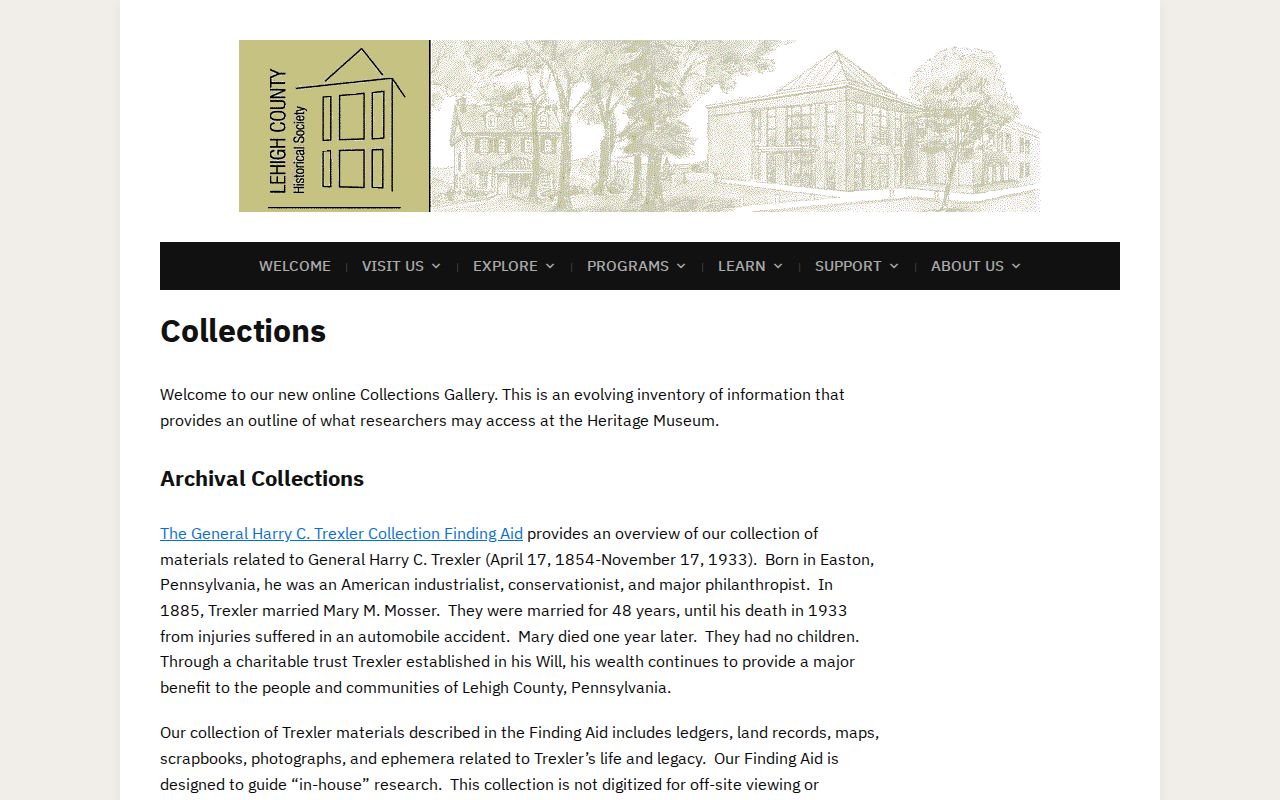
The holdings display points to a repository with several companion record types. It does not show a verified township directory result, which is why a volume-level citation remains essential.
Note: A complete citation makes a regional directory lead reviewable without converting it into an unsupported present-day address claim.